

Grounding Europe’s Energy Transition in the Realities of Small-Scale Fisheries
Achieving climate neutrality by 2050 will require not only technological innovation, but also policies that are firmly rooted in social, economic and environmental realities. In this context, grounding the EU’s energy transition in the lived experience of fishers and coastal communities is essential for ensuring both effectiveness and fairness.
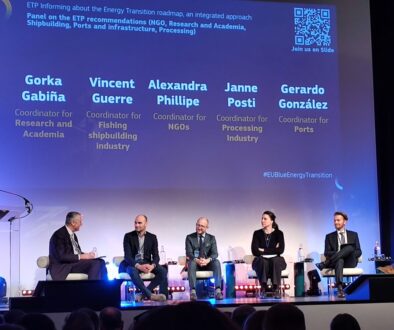
The Energy Transition Partnership (ETP), established by the European Commission, has recently published its joint and sector-specific considerations to support the development of the Commission’s Energy Transition Roadmap. These documents are the result of extensive dialogue within the ETP Support Groups and aim to identify shared priorities, sectoral challenges and areas for cross-sector alignment.
The Seaglow Project followed this process closely, with two consortium members contributing directly as Support Group Coordinators: Gorka Gabiña Iribar (Academia Working Group) and Marta Cavallé (Small-Scale Fisheries Working Group). Their involvement helped ensure that both scientific evidence and the realities of small-scale fishing communities were meaningfully reflected in the final recommendations.
Small-scale fisheries at the forefront of decarbonisation
The considerations developed by the Small-Scale Fisheries (SSF) Working Group underline a key message: small-scale, low-impact fisheries already operate with a very low carbon footprint and are therefore at the forefront of the energy transition. Rather than being treated as a sector that must adapt to externally designed solutions, SSF should be recognised as an existing model of low-impact food production and placed at the heart of European fisheries and climate policies.
At the same time, the Working Group highlights deep structural challenges threatening the future of the sector. These include ageing fleets and fishing populations, limited access to investment, declining availability of fish in inshore waters, restricted access to resources and markets, and growing displacement by other blue economy activities. Without addressing these issues, the energy transition risks exacerbating existing vulnerabilities.
A central recommendation is the urgent need to restore fish stocks, particularly in coastal and inshore waters. Healthier stocks would significantly reduce energy use by shortening fishing trips and time at sea, while also improving economic viability and contributing to natural carbon sequestration in marine ecosystems.
Marta Cavallé, Small-Scale Fisheries Working Group Coordinator, said:
“Small-scale fisheries are already part of the solution to Europe’s energy transition. With their low carbon footprint and close connection to coastal ecosystems, they show that climate ambition, sustainable food production and community livelihoods can reinforce each other. But without healthy fish stocks, secure access to resources and tailored public support, the transition risks remaining theoretical for many small-scale fishers. So, a necessary prerequisite for us is for Europe to develop a plan to secure a better future for small-scale fishers by improving viability, restoring fisheries, recognising SSF tenure, providing fair access to resources and access to markets, through a differentiated approach to SSF and Large-Scale Fisheries (LSF) as key measures.”
Evidence, data and research as foundations for transition
Alongside sectoral recommendations, the Research Organisations and Academia Working Group stresses that the energy transition in fisheries and aquaculture must be underpinned by robust, shared and policy-relevant evidence. Applied research findings are still too often fragmented across institutions and projects, limiting opportunities for innovation and slowing progress.
The Working Group highlights the need to establish harmonised and trusted and data-sharing mechanisms for energy use, emissions and fleet characteristics, linked to broader EU digital transition efforts and demonstrator activities enhancing the capacity building and adoption of new technologies and solutions by the sector. Developing reliable baseline studies of the EU fleet, mapping energy demand across regions, and assessing the feasibility of different transition pathways are seen as essential prerequisites for setting realistic, affordable and differentiated decarbonisation goals. Building trust around data sharing is critical to ensure that monitoring frameworks support, rather than hinder, sectoral engagement.
Gorka Gabiña Iribar, Academia Working Group Coordinator, said:
“The energy transition will only succeed if it is based on solid evidence and a clear understanding of how fisheries and aquaculture actually operate. This requires better data sharing, reliable baselines, demonstrators and closer collaboration between researchers, stakeholders, industry and policy makers. Seaglow contributes to this by connecting applied research with real-world conditions, helping ensure that transition pathways are realistic, regionally adapted and informed by both scientific knowledge and operational experience.”
The joint ETP considerations will inform discussions at the high-level Energy Transition Partnership Conference, taking place on 17 February 2026 in Brussels (SPARKS Meeting). Seaglow partners will attend and contribute to the policy dialogue, continuing to advocate for an energy transition that is fair, evidence-based and grounded in the realities of fisheries and coastal communities.
 English
  Danish
  Dutch
Dutch  Estonian
  Finnish
  French
  German
  Latvian
  Lithuanian
  Norwegian
  Polish
  Swedish