

Beskyttelse af skrog og marine liv: PMA-605 afprøver biocidfri belægning i Estland
SEAGLOW’s Estonian demonstration vessel, PMA-605, has received a new hull coating that tackles marine fouling without relying on biocides. Applied over the past summer, the treatment is part of the project’s work to assess alternatives to conventional antifouling paints, with a particular focus on their effects on marine life.
Developed by project partner Clean Ocean Coatings, Ecoating® uses a hard, non-porous surface rather than the release of biocidal substances to manage marine growth. Its application on PMA-605 will help SEAGLOW assess environmental performance, durability and maintenance requirements under everyday fishing conditions.
Preparing PMA-605 for the trial
Owned by Argo Mengel, PMA-605 is a glass-fibre reinforced plastic fishing vessel measuring 11.70 metres in length and 3.10 metres in width. Operating at a cruising speed of 6–7 knots, it provides a practical setting for assessing the coating’s suitability for small-scale fisheries.
The vessel was hauled out at Liu Paat Shipyard (Paadimeistri), near Pärnu, Estonia. Approximately 38 square metres of underwater hull surface were prepared and coated.
High-pressure washing first removed marine growth and loose deposits. KL Soodaprits OÜ then sandblasted the hull to strip away the existing coating layers. Localised gelcoat repairs, sanding and cleaning followed, preparing the surface for the new protective system.
Applying the new coating system
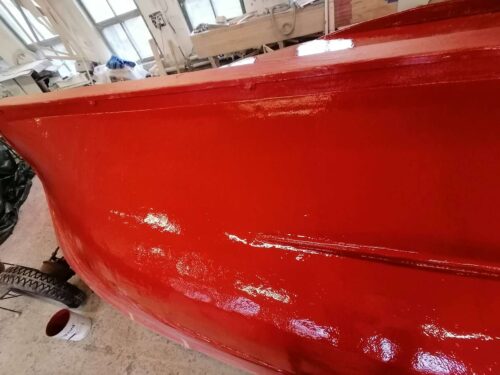 The team began by applying five layers of black VC Tar2, a two-component epoxy primer designed to protect the hull against water ingress and osmosis.
The red Ecoating® topcoat was then applied by an experienced technician using a specialised two-component airless spray system. WIMA Verfahrenstechnik GmbH supplied the spray equipment, while Cramo Estonia AS provided and installed the compressor equipment.
The resulting system combines a protective primer with a durable topcoat intended to withstand repeated cleaning throughout its service life.
A different approach to marine fouling
Conventional biocidal antifouling paints release active substances to discourage organisms from settling on a vessel’s hull. These substances can also affect marine life beyond the organisms they are intended to control.
Ecoating® takes a different approach. Its smooth, hard surface is designed to make it more difficult for marine growth to attach, without relying on biocide release or an eroding coating layer. Attached growth can be removed through mechanical cleaning, while sufficient water movement across the hull can also support a foul-release effect.
Reducing the environmental pressures associated with conventional antifouling is the principal motivation for testing this coating within SEAGLOW. The project’s assessments therefore examine not only how the coating performs on working vessels, but also its interaction with the surrounding marine environment.
Building evidence under real conditions
The application on PMA-605 marks the beginning of a longer assessment. Monitoring will help establish how the coating performs over time, how frequently it needs cleaning and whether it offers a practical alternative for fishing vessel owners. It will contribute to a clearer picture of how small-scale fisheries can protect their vessels while reducing pressures on marine ecosystems.
Photo credit @Hanrymurumaa and @Seaglow

 Danish
  English
  Dutch
Dutch  Estonian
  Finnish
  French
  German
  Latvian
  Lithuanian
  Norwegian
  Polish
  Swedish