
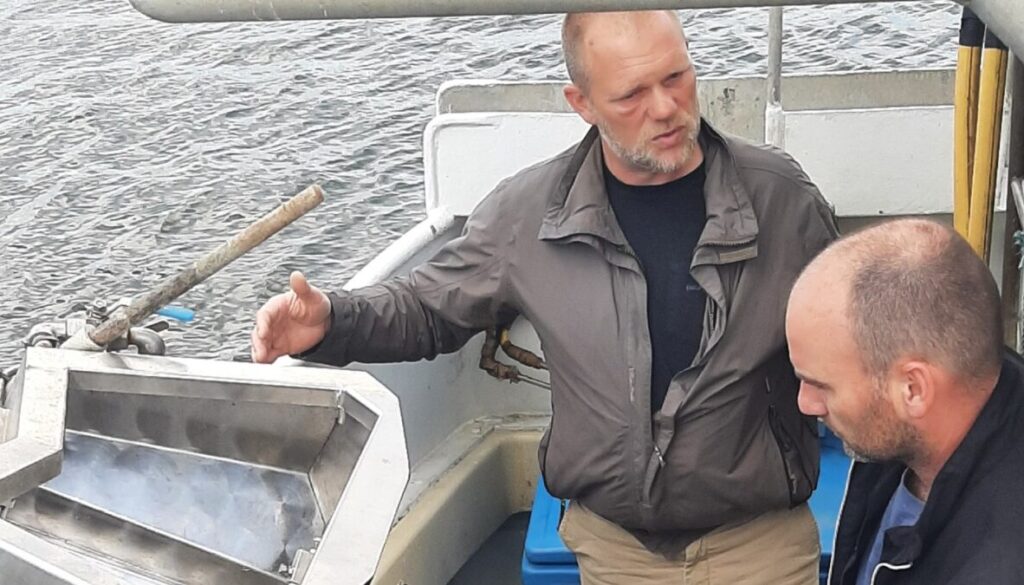
A Conversation with Allan Vestergaard, Fisherman and Vessel Owner: Bringing Hybrid Solutions into Everyday Fishing with SEAGLOW
Allan Vestergaard has spent more than three decades at sea. As owner and skipper of the vessel T 247 Ester, one of the four boats tested within the SEAGLOW project, Allan brings deep hands-on experience from small-scale fisheries.
T 247 Ester is a 10-meter, single-handed fishing vessel operating from Hanstholm (Denmark) on day trips in the North Sea. Each trip consumes around 100 litres of marine gas oil, with the engine running approximately 1,700 hours per year. Based on this operational profile, SEAGLOW selected Ester to test a plug-in parallel hybrid drivetrain, alongside complementary efficiency measures including biocide-free E-coating, fuel and operational monitoring, and custom-designed hydrofoils. The retrofitting is foreseen for autumn 2026, enabling evaluation under real fishing conditions.
In this interview, Allan shares his perspective as both fisherman and vessel owner, offering a practical view on what the green transition means for daily operations, working conditions on board, and the long-term sustainability of the fishing sector.
Can you tell us a bit about your background as a fisherman?
I have been fishing since 1990. Today, I own and operate the small hook and gillnet vessel T 247 Ester, which is 10 meters long. I primarily fish cod and haddock using hooks, and hake using gillnets.
Earlier in my career, I was owner or co-owner of several trawlers, including HM 468, three vessels named Bona-Fide, HM 228 Pondus, and HM 229 Pingo. Those experiences gave me a good understanding of both small-scale and larger fishing operations.
What does a typical fishing trip looks like for you?
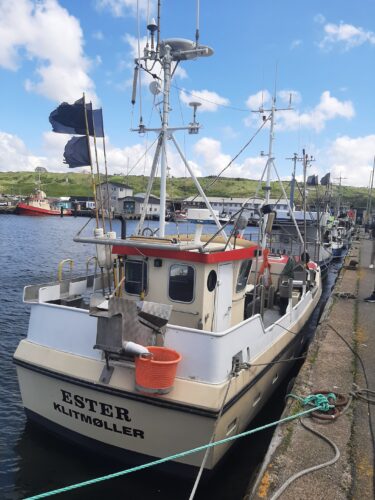 It depends on the season and the fishing method.
In winter, I fish cod and haddock using longlines. A typical trip involves around 4,000 hooks that need to be baited. We usually leave port around 4:00 in the morning so we can set the lines before sunrise. About an hour later, we start hauling the lines, removing the catch, cleaning it, and icing it on board. Once all lines have been set and hauled, we return to port, usually between 16:00 and 18:00.
The preparation is extensive. The day before fishing is spent thawing and preparing bait, and after landing it takes about two full working days to prepare the hooks again. In total, one fishing trip involves roughly four working days.
In summer, I fish hake using gillnets. We typically use around 70 nets, which are set and hauled on the same day. The rhythm is similar—early departure, setting and hauling the nets, cleaning and icing the catch, and landing in the evening. The catch is sold at auction the next morning. Compared to longline fishing, gillnet fishing requires less onshore labor.
How does the fishing sector view the green transition and alternative fuels?
The sector is very aware of the need to find alternative fuels. This is driven both by the green transition itself and by the gradual introduction of CO₂ taxation in fisheries. Fishermen are generally very conscious of protecting nature and want to harvest resources sustainably in the long term.
That said, the industry is also highly dependent on economic realities. Future quotas, quota fluctuations, constant regulation at both EU and national levels, and even geopolitical developments outside the EU all have a strong influence. In some periods, these pressures mean that alternative solutions are unfortunately deprioritized.
What role can SEAGLOW play in supporting the fishing sector?
SEAGLOW plays an important role by turning theory into practice. The project provides concrete knowledge about new operational models, their costs, and the barriers associated with transitioning to green fuels.
What really makes a difference is that solutions are tested on real fishing vessels. That practical experience makes new opportunities visible and credible to the wider sector.
SEAGLOW also looks closely at the economics—both for retrofitting existing vessels, which is often disproportionately expensive, and for newbuild programs, where the green transition can be integrated more efficiently. This helps ensure better value for money when using subsidy schemes.
Finally, the project compares the operating costs of green and traditional vessels, which is crucial for decision-making. Regardless of whether we talk about retrofitting or newbuilds, co-financing through subsidies will be essential for the fleet’s transition. SEAGLOW could contribute even more by expanding to include more vessels and larger segments of the fleet.
What benefits do you expect from the solutions tested in SEAGLOW?
We expect immediate fuel savings of around 20–30%, along with reduced CO₂ emissions when operating on HVO diesel.
The working environment will also improve significantly. The electric hybrid system is very quiet and will mainly be used during deck work, where noise levels are normally highest. That makes a big difference for the fishermen on board.
In the longer term, greener and CO₂-controlled fishing methods could also have a positive impact on settlement prices for the catch. Economically, however, we don’t expect major savings overall, since HVO diesel is still significantly more expensive than traditional marine diesel.
What should SEAGLOW focus on in the future?
SEAGLOW should continue to focus strongly on practical experience and on the private vessels and actors participating in the project—also from a financial perspective. There are still many unknowns and barriers, and the vessels involved carry the greatest risk, both economically and operationally.
Major physical interventions on vessels can lead to lost fishing time and depreciation. These losses can be substantial and cannot always be recovered later. That’s why fishermen need guarantees, collateral, or similar safeguards when participating in such projects.
Fuel availability is another key barrier. For example, green methanol currently has very limited production capacity in Denmark and is already in high demand.
Hybrid electric solutions, like those in SEAGLOW, are very promising—but mainly for smaller vessels with short fishing trips. Larger vessels may eventually rely on methanol or ammonia, but that requires infrastructure, fuel availability, major vessel conversions, and additional crew training.
At the same time, the fishing sector is relatively small. With fewer vessels, suppliers are not developing products specifically for fisheries. We will largely have to follow solutions developed for the wider European industry and shipping sectors.
What message would you like to send to policymakers and technology developers?
Decision-makers need to understand that new fuels require space—both for fuel volume and tank capacity. At the same time, hybrid systems and engines tailored specifically for fisheries are not being developed.
This makes the current EU fisheries regulation based on tonnage and kW a major obstacle. Under these constraints, it is simply not possible to carry out a real green transition—especially for medium-sized (12–24 meters) and large vessels over 24 meters. Future solutions will inevitably involve changes in volume and power, and regulation needs to reflect that reality.
Photo credits @Seaglow
 English
  Danish
  Dutch
Dutch  Estonian
  Finnish
  French
  German
  Latvian
  Lithuanian
  Norwegian
  Polish
  Swedish